WHOLESALE KITS / TEN MATCHING VIALS EACH
Wholesale kits.
Direct catalog pricing.
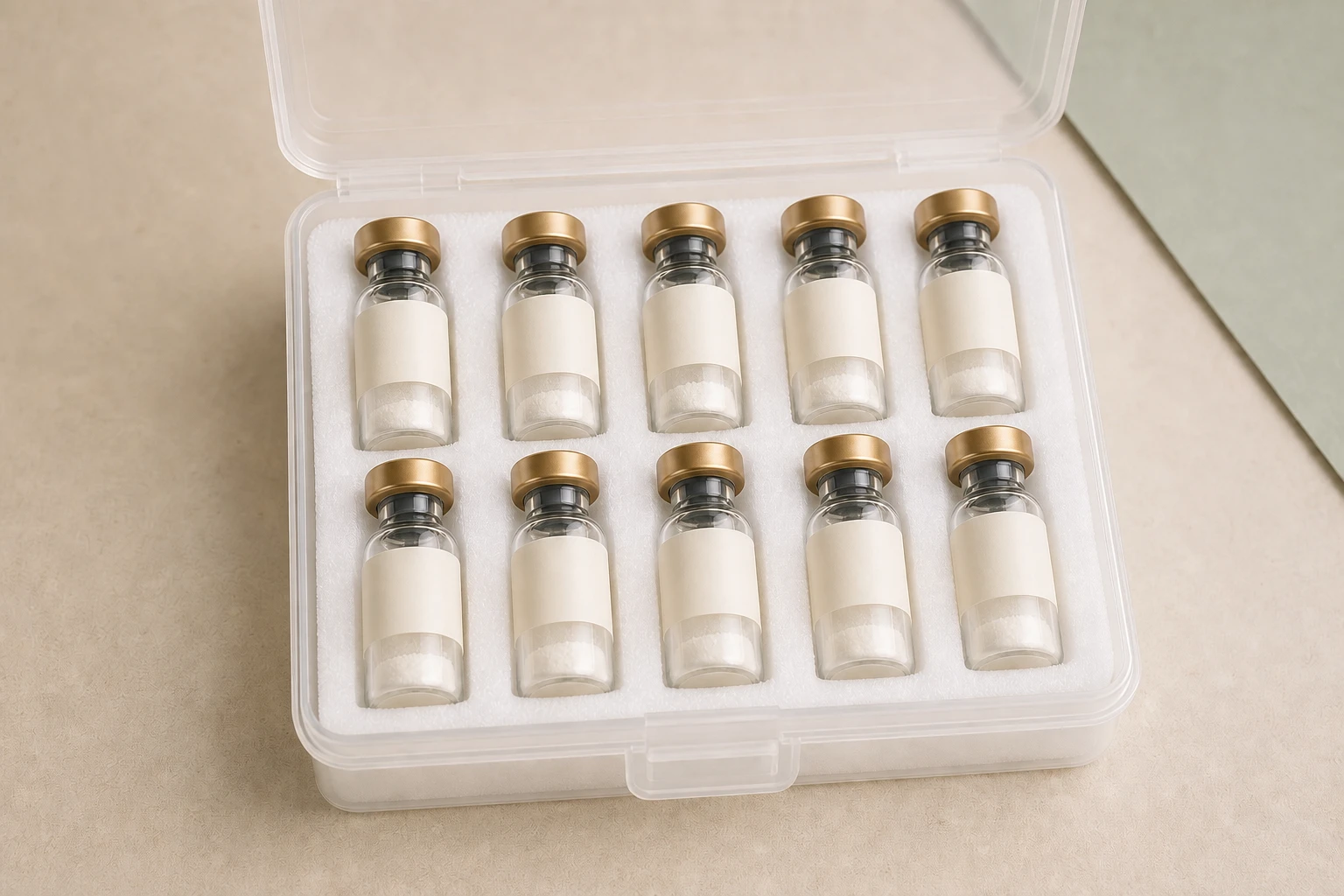
Start with our primary Wholesale Kit catalog: ten matching, clearly labeled lyophilized research vials per kit. Single vials remain available below when a full kit is not needed.
- Primary format
- Wholesale Kits · 10 vials each
- Order process
- Instant Bitcoin or reviewed payment request
- Fulfillment
- Tracked Priority Shipping · estimated 3–5 business days after dispatch
PRIMARY CATALOG / OPEN MEMBER WHOLESALE
Wholesale Kits.
Ten vials each.
Our main catalog is built around complete kits of ten matching vials, with fast, discreet tracked U.S. shipping. Browse every standard kit and price first; single-vial inventory remains available farther down the page.
Shop Wholesale Kits ↗LIVE CATALOG COLLECTIONS
A faster way into the catalog.
Order activity, restocks, and availability are derived from the current PSC catalog—not promotional placeholders.
CATALOG / QUICK START
Start with a few catalog highlights.
Real products, current listed prices, and direct links into the full peptide catalog.
VIAL FORMAT / LAB HANDLING
Lyophilized now.
Reconstituted for research.
PSC catalog items are supplied as lyophilized—freeze-dried—research material.
Reconstitution is required before research use. Solvent choice and procedure vary by material; use a validated compound-specific protocol.
Store unopened lyophilized vials frozen. After reconstitution, refrigerate for short-term research handling unless a validated compound-specific protocol requires different conditions.
NEW ARRIVAL – LIMITED TIME OFFER / OPEN TO EVERYONE
COMPLETE KITS10 vials each13 limited-time selections from $65
Checking availability · 13 selections
Limited-time pricing on complete kits of ten.
Explore thirteen new-arrival specials, mix and match the kits you want, and check out through the same verified member cart when you are ready.
See limited-time prices10 VIALS PER KIT · $20 PRIORITY SHIPPING · 1–10 KITS ONLINE
DISCOVER / RESEARCH FOCUS
Find research materials by category.
62CATALOG ITEMS
01Metabolic10 catalog items
Tirzepatide · R-300TA · Cagrilintide
Browse Metabolic →02Recovery4 catalog itemsBPC-157 · TB-500 / Wolverine Peptide · KPV
Browse Recovery →03Growth6 catalog itemsIpamorelin · IGF-1 LR3 · Sermorelin
Browse Growth →04Cognitive9 catalog itemsSemax · Selank · DSIP
Browse Cognitive →05Blends6 catalog itemsGLOW Blend · Wolverine Blend · Sermorelin / Ipamorelin
Browse Blends →06Cosmetic6 catalog itemsGHK-Cu · GHK Basic · Pal-GHK
Browse Cosmetic →07Immune2 catalog itemsLL-37 · Thymosin Alpha-1
Browse Immune →08Bioregulator11 catalog itemsEpithalon · Bronchogen · Cardiogen
Browse Bioregulator →09Specialty8 catalog itemsKisspeptin-10 · PNC-27 · PT-141
Browse Specialty →SINGLE-VIAL INVENTORY / DIRECT CATALOG PRICING
Shop individual research vials.
Every price in this section is for one single vial. Need ten matching vials? Compare our Wholesale Kit inventory and kit pricing →
Priced formats listed
METABOLIC7/7 PRICED
Tirzepatide
Dual incretin agonist research material
FOR RESEARCH PURPOSES ONLY · CATALOG ITEM
Current catalog status
7 priced formats listed
SINGLE VIAL FROM$34.00Details
Priced formats listed
Contact for availability and pricing
METABOLIC0/2 PRICED
Cagrilintide
Long-acting amylin analogue
FOR RESEARCH PURPOSES ONLY · CATALOG ITEM
Current catalog status
2 contact for availability and pricing
CATALOG STATUSContact for availability and pricingDetails
Priced formats listed
Priced formats listed
RECOVERY2/2 PRICED
TB-500 / Wolverine Peptide
Thymosin beta-4 research fragment
FOR RESEARCH PURPOSES ONLY · CATALOG ITEM
Current catalog status
2 priced formats listed
SINGLE VIAL FROM$26.00Details
Priced formats listed
Priced formats listed
Priced formats listed
Priced formats listed
Priced formats listed
BIOREGULATOR2/2 PRICED
Epithalon
Synthetic tetrapeptide bioregulator
FOR RESEARCH PURPOSES ONLY · CATALOG ITEM
Current catalog status
2 priced formats listed
SINGLE VIAL FROM$69.00Details
Priced formats listed
Priced formats listed
BLENDS1/1 PRICED
GLOW Blend
BPC-157, TB-500 and GHK-Cu blend
FOR RESEARCH PURPOSES ONLY · CATALOG ITEM
Current catalog status
1 priced format listed
SINGLE VIAL FROM$64.00Details
FACEBOOK + INSTAGRAM ARCHIVE
What customers say
about the experience.
Service feedback, preserved.
Excerpts supplied from PSC’s archived social pages. Product-effect, potency, and purity statements are intentionally excluded. These comments are not scientific evidence or medical claims.
Got here quick too. Definitely ordering again.
Super happy with my order. Shipping was fast and everything was packaged well.
Good prices and no issues at all.
Customer service was helpful when I had a question.
Best supplier I’ve found so far. Everything came on time. I’ll keep coming back.
Very impressed. Shipping was quicker than expected. Nice doing business with them.
Fair price. No complaints here — arrived fast.
I keep ordering from them. Really happy with my purchases.
This site is reliable. The whole process was smooth. Fast delivery too.
I’ve already told a couple friends about this site.
They ship quick. No issues at all.
One of the better places I’ve ordered from. Good value. Would recommend.
Everything went perfect. Got here sooner than I thought. Real happy.
Great experience overall. Their service is on point. Will order more soon.
Shipping was fast too.
Really pleased with my order. Everything felt professional. Good site.
Keeps getting better every time I order. They make it easy. Thumbs up.
Solid company. I never have problems with delivery. Glad I found them.
This is my go-to now. Orders arrive in good condition every time.
Honestly really happy with them. Fast shipping, good prices. Keep it up!
ORDER EXPERIENCE / RETAIL
From cart
to tracking.
Build one cart across single vials, wholesale kits, and limited-time arrivals, then choose immediate Bitcoin payment or request order-specific instructions for another listed option.
- Public catalog
- Current products, strengths, and prices
- New-member offer
- First retail order $1,200+ ships free
- Bitcoin checkout
- Order-specific Bitcoin QR + link
- PSC processing fee
- None
PSC does not add a processing or payment-method fee. Any exchange, wallet, withdrawal, transfer, or Bitcoin network fee charged by a third party is separate and must not be subtracted from the exact BTC request. Read the easy ordering and Bitcoin guide →
- 01SHOP + CARTBuild and review one cart
Add single vials, standard Wholesale Kits, and New Arrivals in any order. Confirm every item and total before checkout.
- 02MEMBER CHECKOUTEnter shipping and accept the terms
Sign in with a verified account, provide the U.S. delivery address, and review the research-use and Bitcoin conditions.
- 03PAY + TRACKChoose the payment path
Bitcoin opens the exact QR and automatic status page immediately. Another listed option submits an unpaid request; wait for PSC’s order-specific instructions before sending.
BITCOIN / PAYMENT HELP
New to Bitcoin?
Follow the illustrated guide.
Choose Bitcoin for an immediate private payment page with the exact amount, QR code, wallet link, and automatic status. If you select another listed option, PSC reviews the order and sends order-specific instructions before any payment is due.
Open the payment guide →Stop before you send.
Use only the order-specific Bitcoin QR or wallet link opened by checkout, then verify the BTC amount, Bitcoin network, and destination exactly. A transfer to the wrong address or network may be permanently lost.
PSC never asks for a password, two-factor code, private key, or recovery phrase.MOLECULAR FIELD GUIDE / 02
Peptide science,
mapped visually.
A peptide is not defined by a marketing category. Its amino-acid order, side-chain chemistry, charge, flexibility, and three-dimensional ensemble shape what researchers can observe.
01 / PEPTIDE ANATOMYNCBI SOURCE ↗
A chain with direction.
Amino acids are linked head-to-tail by covalent peptide bonds. By convention, a sequence is written from its amino terminus to its carboxyl terminus: N → C.
H₂N→ALA—GLY—SER—LEU→COOH
NONPOLARALA · VAL · LEU
Side chains that tend to avoid water.
POLARSER · THR · GLN
Side chains that form favorable polar interactions.
ACIDICASP · GLU
Often negatively charged near neutral pH.
BASICLYS · ARG · HIS
Often positively charged, depending on pH.
Property groups are simplified teaching categories; charge and behavior depend on the full sequence and experimental environment.
COMMON BUILDING BLOCKS
One alphabet, enormous variety.
Proteins commonly use 20 encoded amino acids. Reordering even a short chain produces a different primary sequence.
CONFORMATIONAL ENSEMBLE
Shape is more than a static model.
Hydrogen bonding, charge, hydrophobic effects, backbone flexibility, and disulfide bridges can favor different conformations.
CELL SIGNALING
Binding starts a conversation.
Many peptide signals bind cell-surface receptors, which can relay information through intracellular messengers and kinase cascades.
STEPWISE SYNTHESIS
Built one residue at a time.
Solid-phase peptide synthesis anchors a growing chain to a support so amino acids can be added sequentially.
SEQUENCE-TO-SIGNAL MODEL
How a research question moves from molecule to measurement.
Which residues, in what order?
Charge, polarity, and hydrophobicity.
Flexible shapes available to the chain.
Recognition, affinity, and selectivity.
The measured response in a defined model.
Conceptual research map only. A category or binding observation does not establish a health benefit, treatment, safety, or intended use.
PEPTIDE ARCHITECTURE / 03
Small chains.
Complex signals.
Peptides are short chains of amino acids joined by peptide bonds. Their sequence, length, charge, and three-dimensional conformation shape how they behave in laboratory models.
Hydrophobic Polar Charged
Illustrative amino-acid chain—not a product-specific sequence.
PRIMARY STRUCTUREN-TERMINUS → C-TERMINUS
01020304050607
Sequence variants
Researchers compare residue substitutions, truncations, cyclization, and conjugation to study how structure changes an observed interaction.
Affinity is not the whole story
Association, dissociation, receptor selectivity, and experimental context all influence how binding data are interpreted.
Peptides can change over time
Proteolysis, oxidation, deamidation, adsorption, precipitation, and aggregation are distinct research considerations.
Research areas describe subjects of laboratory investigation—not established health benefits, treatments, or intended uses.
RESEARCH READING / 04
Go deeper than a product name.
Authoritative starting points for understanding peptide chemistry, cell signaling, synthesis, stability, and regulatory status. Search all peptide guides → Browse free learning resources →
From amino-acid sequence to three-dimensional shape
Learn how peptide bonds create a directional chain and how residue chemistry and noncovalent interactions influence molecular structure.
Open NCBI chapter ↗How peptides communicate with cells
A clear introduction to peptide hormones, neuropeptides, growth factors, receptors, and intracellular signal relay.
Explore cell signaling ↗Building peptide chains on a solid support
How Merrifield's stepwise solid-phase method changed peptide synthesis and made automated chain construction possible.
Read the Nobel overview ↗Why peptide molecules can change
An overview of sequence- and environment-dependent oxidation, hydrolysis, adsorption, precipitation, and aggregation.
Read on PubMed Central ↗Peptide versus protein is not a hard wall
Scientific and regulatory communities use overlapping size conventions, so context matters more than one universal residue cutoff.
Review the terminology ↗Research status is not drug approval
Being studied, listed as research material, and FDA-approved are different statuses. Drugs@FDA is the live source for approved drug records.
Check Drugs@FDA ↗